
The 7R Pattern: Faith, Relationship, and Spiritual Growth
One of the three essential parts of My Witness Tree is the 7R Pattern. MWT seeks to cultivate an environment where this pattern can be realized for each person. MWT becomes most meaningful when people actively engage in one or more parts of this pattern. Once applied, the 7Rs can become an invaluable asset in helping people increase the frequency and impact of their witnesses of God.
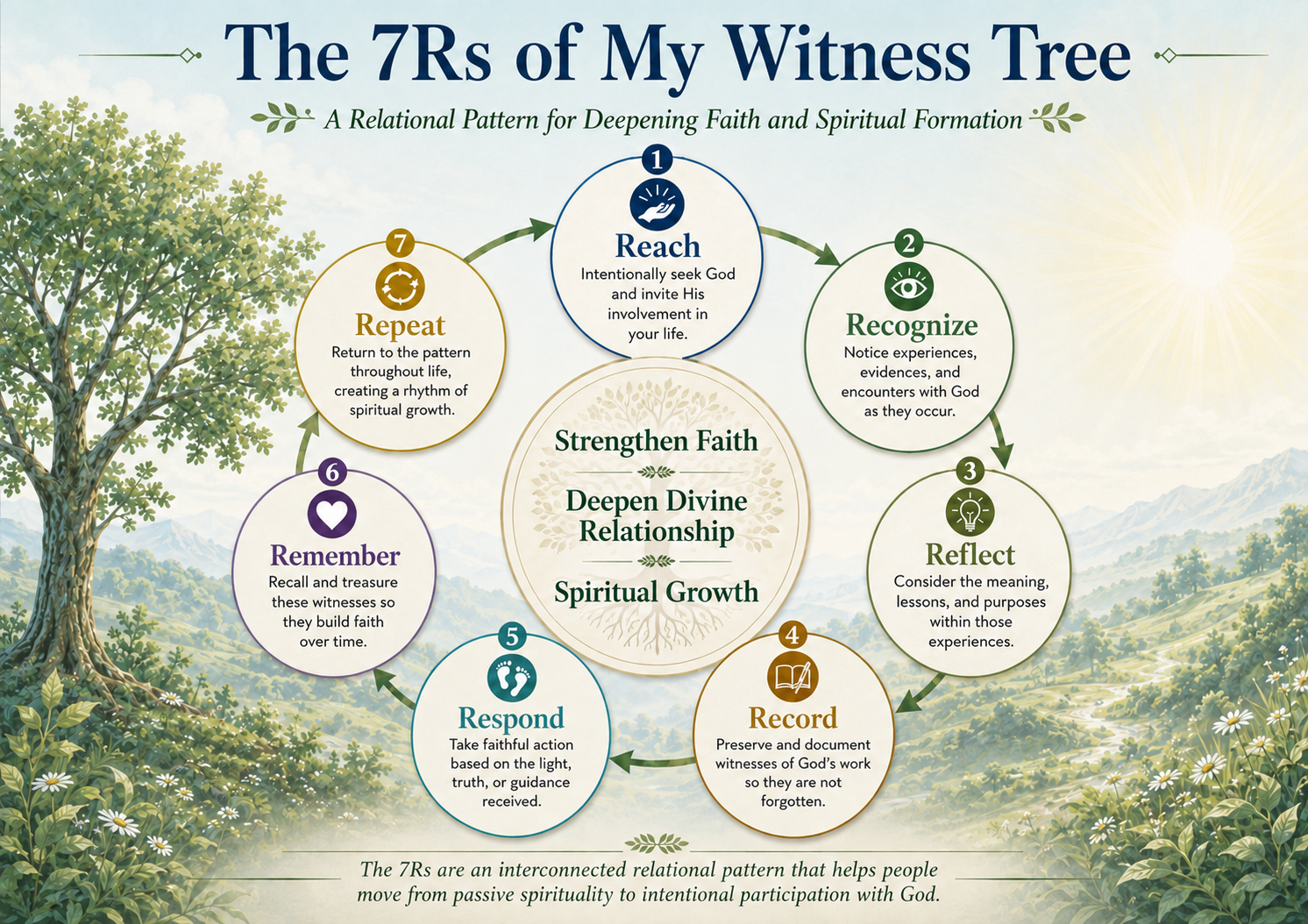
It is important to understand that the 7Rs are not a rigid sequence that must be completed in order—or repeated in full every day. Different experiences may call for different parts of the pattern. The purpose is to keep each part of the pattern available and engage the phases that best fit the moment. These repeated and often overlapping practices can help us engage more intentionally in our relationship with God.
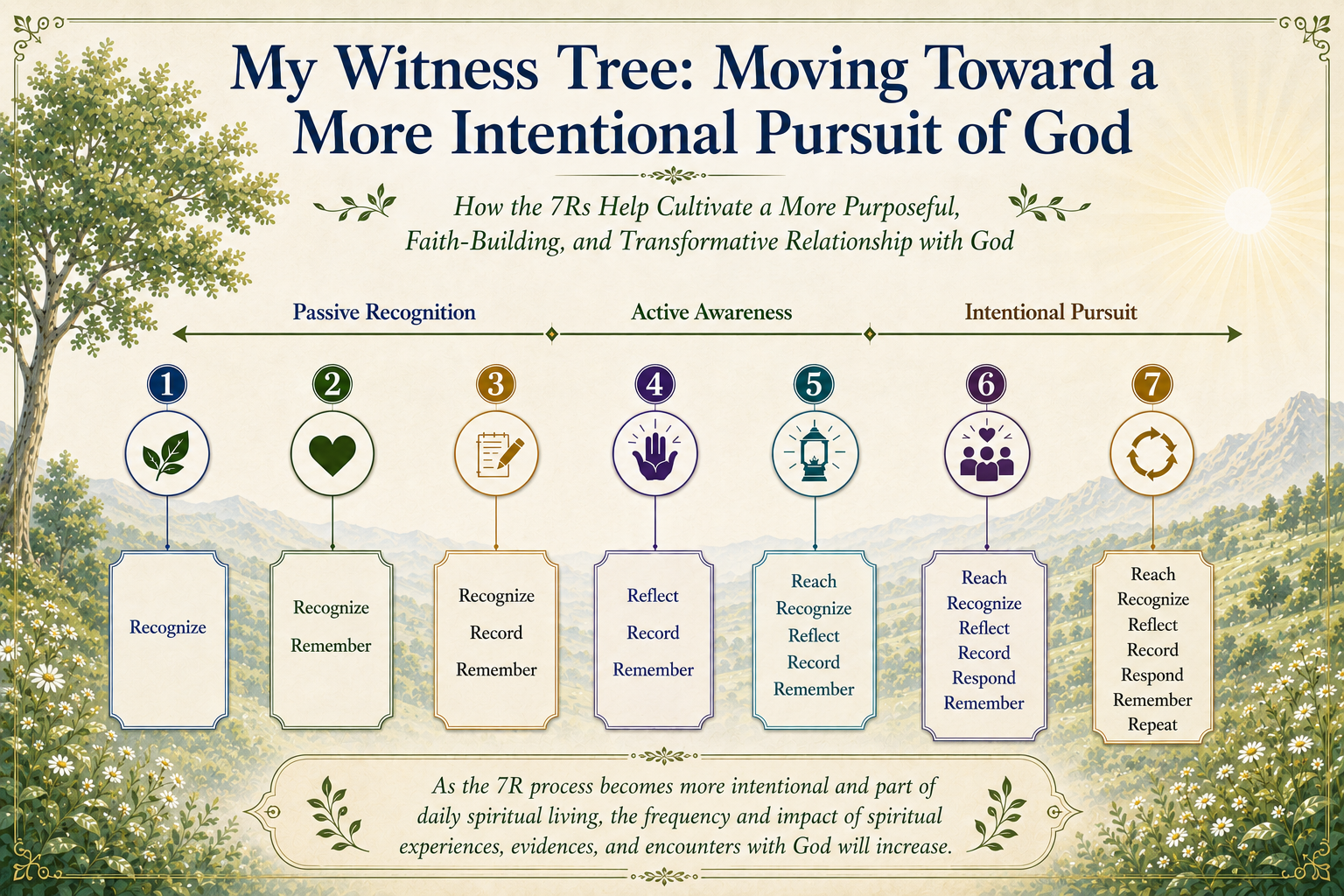
Passive Recognition. Active Awareness. Intentional Pursuit.
As people purposefully and consistently apply more and more of the parts within this pattern, they will experience a shift from passively recognizing God’s influence to actively being aware of intentionally seeking encounters with Him.

Reach
“Instead of passively waiting for God to touch our life, we should intentionally act in order to experience Him more frequently.”
To spiritually reach, or seek, doesn’t mean to casually try and connect with God. Rather, it means to give your heart, might, mind, and strength in meaningful pursuit of God each day. That may look different at various times in our lives—even day to day. But God has asked us to do what we can each day to hear and know Him better. Instead of passively waiting for God to touch our life, we should intentionally act in order to experience Him more frequently. Those who persistently seek with real intent will come to find that God truly is waiting for us to connect with Him.
Truly seeking Him each day is just as much about the condition of our heart as the things we actually do. The true condition of our heart will be reflected in how we reach for or seek Him.
Recognize

“While we desperately want to experience the incredible and obvious, God most often touches our lives in gentle and subtle ways.”
Recognize invites us to slow down and take time to consider how and when God touched our lives. Being able to recognize His influence requires effort, humility, and faith. It requires spiritually sensitive eyes and ears. It requires a soft and willing heart. It requires experience, practice, and patience. While we desperately want to experience the incredible and obvious, God most often touches our lives in gentle and subtle ways. If we have eyes to see and ears to hear, we will begin to more readily learn how much He reaches out and touches our life for good as a witness of the love He has for us.
How often has God done something for us that we did not slow down to recognize or were not sensitive enough to see? The more intentionally we look for God’s influence, the more prepared we become to recognize it.
Reflect

“We do not believe that God gives us divine moments simply to be like a temporary warm blanket or a souvenir that sits on a shelf collecting dust.”
Each divine experience or evidence brings an opportunity for meaningful learning. We don’t believe that God gives us divine moments simply to be like a temporary warm blanket or a souvenir that sits on a shelf collecting dust. He has greater purposes in gifting them to us. One of those purposes is to give us opportunities to learn incredibly important things about God and ourselves.
It is through reflection and pondering that we can come to gain greater understanding, light, and knowledge. This additional truth leads to improved obedience, seeking, and other spiritual behavior. In short, learning from our sacred experiences helps us become the type of people God intends for us to be.
Record

There is an old Chinese proverb that wisely states, “The palest ink is better than the best memory.”
The importance of recording our witnesses cannot be overstated. In our busy world, taking the time to record experiences can be a major obstacle. Keeping a physical or digital record of our experiences is one of the very best ways to preserve our experiences with God. Most of you reading this can likely recall significant experiences that you have had with God in your life. They are precious to you. However, even those will fade with time no matter how well we think we can remember. And what of the many small and simple things you have seen, felt, or heard that quickly faded and were forgotten? There is a old Chinese proverb that wisely states, “The palest ink is better than the best memory.”
Today we have the ability to record and preserve our sacred memories better than ever before. By taking the time to record them as soon as possible with words, photos, videos, and audio files, we are preserving an accurate repository of witnesses that can help us see how much God is in the details of our life. These records can strengthen individuals and families during times of trial and can also bless future generations. It is a powerful way to continue bearing witness even when we are not around or after we are gone.
Respond

“Each connection with God is like a personally wrapped gift. Gifts are given with intent—often with the expectation and hope that they will be used to benefit the life of the receiver.”
Learning how to respond to God’s influence in our lives is foundational to spiritual growth. One reason God touches our lives is to give us opportunities to faithfully act in response. Each connection with God is like a personally wrapped gift. Gifts are given with intent—often with the expectation and hope that they will be used to benefit the life of the receiver. Faithful response can be scary and require incredible faith but doing so will lead to unseen blessings, joys, and opportunities God has in store for us.
While not every witness of God invites a response beyond recording, each time we do recognize His influence in our lives, a few questions should come to our minds that deserve reverent consideration. For example, “For what purpose did God do this in my life?” or “Is there something I need to do because I had this experience?” The answers to those questions can vary greatly. We may feel invited to share it with another, make a small change for the better, serve someone, or trust God and follow inspiration. As we learn to consistently and proactively respond, we believe that God will provide more and more invitations to respond.
Remember

“Our willingness and effort to remember is a critical part of being able to maintain a clear vision that God clearly sees us.”
It is one thing to recognize and experience God’s influence; it is quite another to be able to remember that it ever happened. By remembering that a sacred moment happened, it can continue to burn bright and actively influence our life for good. Remembering is much more than recording. It is something that happens after an event happens and is preserved in our memory or by some other means. It is often spontaneous but it can just as easily be intentional. Remembering takes effort. Taking time and effort to reread and ponder over our recorded experiences can be incredibly powerful, uplifting, confidence building, and inspiring.
Our willingness and effort to remember is a critical part of being able to maintain a clear vision that God always sees us clearly. If we neglect to actively find effective ways to remember, we will almost certainly forget. The spiritual truth attached to a specific experience which once burned bright in our heart and mind, will eventually fade if neglected.
Repeat

“Our efforts to connect with God ought to be a daily, on-going transformative process.”
This final phase of the 7R Pattern emphasizes the idea that our efforts to connect with God ought to be a daily, ongoing transformative process. The “leaves” God gives us shouldn’t be viewed as isolated events but rather understood as a network of interconnected experiences that continually strengthen and nourish the tree—deepening roots, growing branches, and producing fruit.
Repeat does not mean that we must return to Reach and complete all seven phases in order. The invitation is to purposefully and consistently return to this relational pattern throughout life, engaging whichever parts are appropriate to the situation or experience. This effort will lead to outcomes are plentiful and precious. My Witness Tree never claims to be the source of experiences, change, or growth. Rather, MWT seeks to be a tool, means, or pathway through which the frequency and impact of those things can be multiplied and magnified.